
Contents
- 🚀 What is Business Continuity Planning?
- 🎯 Who Needs Business Continuity Planning?
- 💡 Key Components of a BCP
- 📈 The Planning Process: Step-by-Step
- ⚖️ BCP vs. Disaster Recovery: Understanding the Difference
- 💰 Cost and Investment in BCP
- ⭐ Real-World Impact and Case Studies
- 🛠️ Tools and Technologies for BCP
- 🤔 Common Pitfalls to Avoid
- 🏆 Best Practices for Success
- 🌐 Getting Started with Your BCP
- 📞 Contact and Resources
- Frequently Asked Questions
- Related Topics
Overview
Business continuity planning (BCP) is the proactive process of establishing procedures and protocols to ensure that essential business functions can continue during and after a disaster or disruption. It's not just about recovering from an event, but about maintaining operations with minimal interruption. A robust BCP identifies critical business processes, assesses potential threats (natural disasters, cyberattacks, pandemics, supply chain failures), and outlines strategies for mitigation, response, and recovery. Key components include business impact analysis (BIA), risk assessment, and the development of a detailed business continuity plan (BCP) document. Effective BCPs are regularly tested and updated to remain relevant and functional, safeguarding an organization's reputation, financial stability, and stakeholder trust.
🚀 What is Business Continuity Planning?
Business Continuity Planning (BCP) is the proactive process of developing strategies and procedures to ensure an organization can maintain essential functions during and after a disruptive event. It's not just about recovering from a disaster; it's about preventing disruptions where possible and ensuring that critical operations continue at acceptable levels, even when faced with threats like cyberattacks, natural disasters, or supply chain failures. The ultimate goal is to safeguard an organization's ability to deliver its products or services without significant interruption, thereby protecting its reputation, assets, and customer base. A well-structured BCP is a roadmap for resilience.
🎯 Who Needs Business Continuity Planning?
Virtually any organization, regardless of size or industry, can benefit from a robust Business Continuity Plan. Small businesses might focus on localized disruptions like power outages or key personnel absence, while large enterprises must consider global supply chain disruptions or widespread natural disasters. Industries with critical infrastructure, such as healthcare, finance, and utilities, have regulatory mandates and inherent risks that make BCP non-negotiable. Even non-profits need to ensure they can continue serving their communities during crises. Essentially, any entity that relies on consistent operations to fulfill its mission requires a risk management strategy.
💡 Key Components of a BCP
A comprehensive BCP typically includes several core elements. A BIA identifies critical business functions and the potential impact of their disruption. It also defines Recovery Time Objectives (RTOs) and Recovery Point Objectives (RPOs). The plan outlines specific incident response procedures for various scenarios, including communication protocols, emergency contact lists, and evacuation plans. Furthermore, it details strategies for resource allocation during a crisis, such as backup sites, alternative suppliers, and essential personnel roles. Finally, regular testing and plan maintenance are crucial to ensure its effectiveness.
📈 The Planning Process: Step-by-Step
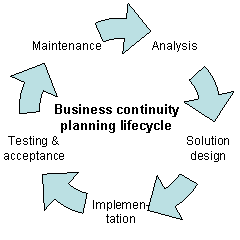
Developing a BCP is an iterative process. It begins with a thorough risk assessment to identify potential threats and vulnerabilities. This is followed by the aforementioned Business Impact Analysis (BIA) to prioritize critical functions. Next, strategies are developed to mitigate risks and ensure continuity, such as data backups, redundant systems, or cross-training staff. The actual plan document is then created, detailing procedures and responsibilities. Crucially, the plan must be regularly tested through drills and exercises, and updated based on test results, organizational changes, or evolving threats. This cycle ensures the BCP lifecycle remains relevant.
⚖️ BCP vs. Disaster Recovery: Understanding the Difference
While often used interchangeably, Business Continuity Planning and Disaster Recovery (DR) are distinct but complementary. BCP is the broader discipline focused on maintaining overall business operations during a disruption, encompassing people, processes, and technology. DR, on the other hand, is a subset of BCP specifically focused on restoring IT infrastructure and data after a disaster. Think of BCP as keeping the lights on and the doors open, while DR is about getting the servers back online. Effective IT resilience relies on both working in tandem.
💰 Cost and Investment in BCP
The investment in Business Continuity Planning can vary significantly based on an organization's size, complexity, and risk profile. While there are costs associated with developing the plan, implementing protective measures (like redundant systems or backup power), and conducting regular training and testing, these are often dwarfed by the potential losses from an unmitigated disruption. These losses can include lost revenue, reputational damage, regulatory fines, and even business failure. Many organizations view BCP not as an expense, but as a critical investment in organizational resilience and long-term survival.
⭐ Real-World Impact and Case Studies
Numerous real-world events underscore the importance of BCP. Following the 9/11 attacks, many New York City financial firms with robust BCPs were able to resume trading within days, while others struggled significantly. The 2011 Tohoku earthquake and tsunami in Japan highlighted vulnerabilities in global supply chains, prompting many companies to diversify their suppliers and enhance their supply chain management strategies. More recently, the COVID-19 pandemic forced a massive, unplanned shift to remote work for millions, testing the limits of existing BCPs and accelerating the adoption of flexible work policies and digital transformation initiatives.
🛠️ Tools and Technologies for BCP
A range of tools and technologies can support Business Continuity Planning. Specialized BCP software platforms can help manage risk assessments, BIAs, plan documentation, and communication workflows. Cloud-based backup and recovery solutions offer flexible and scalable options for data protection and IT system restoration. Communication platforms, such as emergency notification systems and collaboration tools, are vital for coordinating responses during a crisis. Even simple tools like shared spreadsheets for contact lists and asset inventories can be effective for smaller organizations. The key is selecting tools that align with the organization's specific needs and IT infrastructure.
🤔 Common Pitfalls to Avoid
Organizations often stumble in their BCP efforts due to common pitfalls. A frequent mistake is treating BCP as a one-time project rather than an ongoing process, leading to outdated plans. Insufficient testing is another major issue; a plan that hasn't been validated through exercises is unlikely to perform under pressure. Lack of executive buy-in can starve BCP initiatives of necessary resources and authority. Furthermore, failing to involve all relevant departments, from IT and operations to HR and legal, can create gaps in the plan. Finally, neglecting employee training on their roles during a crisis leaves the organization vulnerable. Avoiding these traps is key to effective business resilience.
🏆 Best Practices for Success
To build an effective BCP, several best practices should be followed. Ensure strong leadership commitment from the outset, making BCP a strategic priority. Conduct thorough and regular risk and impact analyses to understand your unique vulnerabilities. Develop clear, concise, and actionable plans that are easily understood by all stakeholders. Implement a robust testing and exercise program, varying the scenarios and participants. Establish clear communication channels and protocols for both internal and external stakeholders. Finally, foster a culture of preparedness throughout the organization, where continuity is everyone's responsibility. This approach builds true organizational preparedness.
🌐 Getting Started with Your BCP
Getting started with Business Continuity Planning involves a structured approach. First, secure executive sponsorship to ensure the initiative has the necessary authority and resources. Assemble a BCP team representing key departments. Begin with a high-level risk assessment to understand the most probable and impactful threats your organization faces. Conduct a BIA to identify critical functions and their dependencies. Based on these findings, develop continuity strategies and document them in a formal BCP. The next crucial step is to test the plan and refine it based on the results. Continuous improvement is the hallmark of effective BCP.
📞 Contact and Resources
For further assistance with your Business Continuity Planning needs, consider consulting with specialized BCP firms or IT disaster recovery service providers. Many offer BCP consulting services that can guide you through the assessment, planning, and testing phases. Resources like the FEMA provide valuable guidance and templates for developing emergency preparedness and continuity plans. Engaging with industry-specific associations can also offer tailored insights and best practices relevant to your sector. Don't hesitate to reach out to experts to ensure your organization is adequately prepared for the unexpected.
Key Facts
- Year
- 1979
- Origin
- The concept of business continuity planning gained significant traction following major disruptions in the late 20th century, with formal frameworks emerging in the 1980s and 1990s, notably influenced by standards like ISO 22301.
- Category
- Business Management
- Type
- Concept
Frequently Asked Questions
What is the difference between Business Continuity and Disaster Recovery?
Business Continuity Planning (BCP) is the overarching strategy to ensure an organization can continue essential operations during and after a disruptive event. Disaster Recovery (DR) is a component of BCP that specifically focuses on restoring IT infrastructure and data after a disaster. BCP is about maintaining operations, while DR is about recovering IT systems.
How often should a Business Continuity Plan be updated and tested?
A BCP should be reviewed and updated at least annually, or whenever significant changes occur within the organization (e.g., new systems, new locations, key personnel changes). Testing should also be conducted regularly, with different types of tests (e.g., tabletop exercises, full simulations) performed at planned intervals, ideally quarterly or semi-annually, to ensure the plan remains effective and staff are prepared.
What are the main threats that a BCP should address?
A BCP should address a wide range of potential threats, including natural disasters (floods, earthquakes, storms), technological failures (power outages, cyberattacks, hardware failures), human-caused incidents (terrorism, strikes, pandemics), and supply chain disruptions. The specific threats prioritized will depend on the organization's industry, location, and operational dependencies.
Can small businesses afford to implement a Business Continuity Plan?
Yes, small businesses can and should implement BCPs. The cost is often less than perceived, and many strategies can be implemented affordably, such as cross-training employees, maintaining off-site backups of critical data, and establishing clear communication protocols. The cost of not having a plan can be far greater than the investment in one, potentially leading to business failure.
What is a Business Impact Analysis (BIA)?
A Business Impact Analysis (BIA) is a critical step in BCP development. It identifies an organization's critical business functions and the potential impact of their disruption over time. The BIA helps determine Recovery Time Objectives (RTOs) – the maximum tolerable downtime for a function – and Recovery Point Objectives (RPOs) – the maximum acceptable data loss. This analysis prioritizes which functions need to be restored first.
Who should be involved in creating a Business Continuity Plan?
Creating a BCP requires a cross-functional team. Key stakeholders typically include representatives from IT, operations, human resources, finance, legal, communications, and senior management. Their diverse perspectives ensure that all critical aspects of the business are considered and that the plan is comprehensive and practical.